Alive and Well Women: Our First Grant!

This week we were notified that our first grant proposal was approved! It was an exciting and encouraging day for Alive and Well Women (and me!). I called my friend and co-founder, Cissy, to squeal and celebrate together in joy on the phone. Another big step for us!

I was particularly thrilled that the grant was from The Sister Fund, a private foundation whose mission is to fund women’s social, economic, political and spiritual empowerment. The founder of The Sister Fund is Helen LaKelly Hunt, Ph.D., who authored Faith and Feminism: A Holy Alliance, a book I recently read and which inspired me greatly.

In the preamble to her book (Gloria Steinem also wrote a lovely introduction), Helen writes, “The search for connection to our wholeness is the overarching theme of this book and of my life…To me there is no separation between faith and feminism. But many feminists have an ardent mistrust of religion, and many women of faith have a strong aversion to feminism…. I began to feel that we need a broader discussion of the vital connection between religious conviction and social action, the alliance between faith and feminism.”

Faith and Feminism explores the roots of the early feminist movement, led by abolitionist feminists of the nineteenth century, whose activism was fueled by their deep faith in God. The book profiles five women, from different centuries and different cultures, but whose “religious and spiritual lives were indivisible from their public achievements.” Through these women’s stories, Helen explores five stages of the “journey to wholeness” – pain, shadow, voice, action, and community. This is a useful framework to consider not only our individual journeys, but also for feminism as a social movement.

I look forward to exploring the issues raised in this book in more detail

I look forward to exploring the issues raised in this book in more detail

In my own life, I am two years into early retirement after a 25-year corporate career as a lawyer and partner with a national employee benefits consulting firm.  I was involved in the leadership of our firm’s Women’s Network, which was designed to help women steer through the pitfalls of a very traditional male-dominated work culture.  I am also a Christian, and in recent years have been involved in the leadership of our local church. Since I retired, I co-founded and was elected Chair of the Board of Alive and Well Women.  Our mission is to help women navigate toxic cultural messages about health, beauty and sexuality so they can thrive amongst the multiple stages of the female life cycle. We support women’s wholeness and empowerment through workshops, classes and programs.

Faith and Feminism gave words to my dual experience of feeling awkward sharing my religious self with many female friends from my corporate working career, while also feeling reticent around church friends due to (what I assumed to be) my too-liberal views on certain social issues.  I often felt straddled between two worlds. Then there is the issue of learning when and where to give voice to my beliefs and opinions – at work, at church, and even with my family (such as my husband who often has different political and social perspectives than I).  Too often, as women, we are taught to be polite, to compromise, to keep the peace, to work toward consensus, frequently to our own detriment or contrary to our true selves. When faced with the inevitable big, loud people who oppose or even threaten our beliefs, when is it appropriate to stay silent, to go quietly around, or to confront?  In the spirit of civility and servanthood, I too often keep my mouth shut and am not completely genuine with others.  In Faith and Feminism, I was above all inspired by the stories of Sojourner Truth and Lucretia Mott, who found their voices, and took action based on their core beliefs.

The book further opened my heart and mind to women’s empowerment, in general, and finding our true voices, in particular, as part of the journey toward wholeness.  I look forward to unpacking these topics in more depth through this blog and to potentially incorporating those themes into our Alive and Well programs. I do feel a passion for helping myself and other women explore ways to heal the rift between faith and feminism and to find our voices and take action. I am excited for the journey!

Fear and Friendship

I am not a courageous person. My older brother claims I was born afraid of everything. This may surprise some, as I have learned confidence over the years. But even today, my Fear List is long and ranges from things I am not particularly fond of to those I hold in stark terror. Darkness, bats, heights, clowns, men with black hair and mustaches (I’ve mostly grown out of that one), to name a few.

When I hike (usually with my husband) I worry about cliffs, bears, falling rocks, drowning in cold water, tripping on roots and breaking my foot. Approximately 75% of the time, I am happy that I powered through, but I am usually more comfortable on the hike back (once I’m familiar with the hazards). In the past week, I walked a mile-long cave in pitch black darkness. One that required lanterns and was billed as habitat to several variety of bats. Then I canoed six miles down a river, about a third of the way going in circles and zig-zagging from shore to shore. And the piece de resistance – I rode a tandem bike with my husband (previously, our first, last, and only tandem bike experience, about 25 years ago, did not, shall we say, go so well). And it was all awesome.

It was awesome mainly because I was with good friends, first on a girls weekend in Oregon and then with my husband, who joined me, and another couple. We are at that sweet spot where we are okay with our limits. And our choices. When someone floated the idea of touring a volcanic lava tube cave, I was perfectly free to ask to be dropped off at Starbucks. Or, as I actually did, I could confess to my friends that I would go in the cave but would likely be slightly nauseous the whole time.

Facing fears is part of growing up. And, even in this later chapter of life, I still have growing up to do. Being a naturally fearful person, I have had to stare fear down all my life, and it sometimes leads to inertia or even failure. But as Eleanor Roosevelt once said “You gain strength, courage and confidence by every experience in which you really stop to look fear in the face. You must do the thing which you think you cannot do.”

My recent adventures illustrate some important principles on approaching fear and anxiety…and the power of supportive friendships in the journey:

First, it was important to recognize and acknowledge the fear. When I heard the words “cave” “dark” and “bats” all in one conversation, I recognized the familiar pit in my stomach. I acknowledged the fear by being honest with myself that I was scared. I was also honest with my friends, who were then able to care for me. There were four of us in the cave with two lanterns, and my “lantern buddy” Kathy graciously let me hold the lantern in a death grip and walked in front of me.

The end of the cave. No sign needed for me to go no further!

The end of the cave. No sign needed for me to go no further!

Second, I embraced the fear. The entire time I was in the cave, I felt uncomfortable. When I was in the canoe, with my friend Monica, we were slightly out of control until we got the physics of rowing under our belts. At one point on the river, we were floating backward and heading for a large tree jutting over the river, and the beginnings of terror were forming in my gut. On the tandem bike, I was riding in back, unable to see where I was going, brake or steer. I was doing the best I could but occasionally my husband would call out “Are you pedaling?!” which indicated I was probably intermittently freezing up or spacing out. But I have learned over the years to distinguish “good” anxiety, which often accompanies growth, from “bad” anxiety, which can be a sign of danger. As long as I am able to tolerate the good anxiety, I am open to experiences and growth that I might otherwise miss if I gave in to fear.

Third, it helped immensely that I could lean on trustworthy people. Good friends are the embodiment of God’s love: “Be strong and courageous.  Do not be afraid or terrified….God goes with you; He will never leave you nor forsake you.” (Deuteronomy 3:16, NIV) I had friends around me that I felt comfortable confiding in, who were not judgmental and who were encouraging and supportive. In the cave, Kathy occasionally asked “How are you doing?” (To which a little girl, coming the other way, responded, in tears “Not so well” which made me feel brave in comparison). On the river, Monica laughed good-naturedly as we spun in circles, saying “Don’t worry, we’ll get the hang of it!” As for the ride on our tandem bikes, my friend Kathy (also my cave lantern mate) encouraged me to give it another try and she and her husband accompanied us and cheered us on.

Our successful completion of tandem bike riding

Our successful completion of tandem bike riding

Finally, celebrate the victories. I have not conquered my fear of caves or the dark or bats or tight places or drowning or falling off a bike. But, as Eleanor Roosevelt said, I gained a measure of strength, courage and confidence with the experience. And in the midst, I felt a profound sense of gratitude and joy. I occasionally stopped in the cave to shine the lantern on the walls, marveling at the structure and grandeur. Our day on the river was beautiful – spectacular weather, breathtaking scenery, and a variety of wildlife. And before this week, I assumed that riding a tandem bike with my husband was not a good idea, when in fact, it was a great idea. When we completed our ride, we did a victory lap for the sole purpose of taking photos. And to celebrate our day of tandem-tandem riding, our foursome went for ice cream and I treated myself to a hot fudge sundae. I am never too old to grow up!

An Homage to Diane, or, Life Lessons I Learned from my Yoga Instructor

Diane is my favorite yoga instructor at the YMCA. She’s been teaching yoga there for over 20 years; I’ve had the good fortune of taking her classes the past two. Last week she announced she’s rolling up her mat and will no longer be teaching. I sniffled all the way home. At my final Gentle Yoga class with her last Wednesday, during savasana, she played “It’s a Wonderful World” by Louis Armstrong and I bawled like a baby into my towel. Why the sadness?

Gentle Yoga classes with Diane have been my refuge, my Happy Place, these past two years. I have come to love yoga, but it was Diane who instilled that love. She taught me yoga, and so much more. For someone I barely know on a personal level, she became an immensely important part of my life.

As I consider my ‘Alive and Well’ journey, yoga has been a key. It has become an essential part of me. When I think about it, I find this somewhat laughable, almost shocking. I am tall, inflexible (I can’t even touch my toes without seriously bending my knees), fairly uncoordinated (a Pilates instructor at the Y once studied my back up-close, thinking I had a serious curvature of the spine, only to conclude that I “just have no sense of where my body is moving”), I don’t much care for pain, and it is almost impossible for me to be quiet and calm my thoughts for any significant period of time. I tried yoga once years ago and was so turned off that I never went back.

But after I retired, I decided to try Gentle Yoga, thinking maybe I could gradually work myself up to “Big Girl” Yoga. My first 90-minute class with Diane flew by (the worst part was when she turned on the lights at the end while I was blissfully laying in corpse pose and suggested we get up and leave) and I felt both energized and relaxed  –  like I’d just returned from a two-week beach paradise vacation somewhere. Two years later, I still don’t do the regular yoga class (the one day I tried, they were all doing headstands) and I’m not much more flexible, but I have experienced profound benefits.

Gentle Yoga, my "Happy Place"

Gentle Yoga, my “Happy Place”

So, what exactly are the life lessons I learned from yoga with Diane?

1) That I can do yoga! And more! This may sound silly, but for someone like me who sits frozen at a 90-degree angle, watching in horror as the limber ones effortlessly dip their “third eyes” (foreheads) to the ground, yoga can feel like it’s just not my thing. “Nonsense!” said Diane. She taught me that I could do my own practice, at my own speed and at my own level.   She showed me modifications, and use of props (blankets, blocks, weights, straps) to help me with the poses. The very first day I showed up at her class, Diane asked me my name, and from then on, I’d hear “Good, Betsy!” or “Don’t go so low, Betsy” or “Try it with the blocks, Betsy.” Her personal encouragement made me believe in myself and kept me coming back. And learning to do yoga on my own terms gave me tremendous confidence to try other things on my own terms. Just because I am not naturally gifted at something doesn’t mean I can’t learn to do it, and enjoy it, even though I may not do it like anyone else. I now look, unashamed,  for the “props” and “modifications” in life that will make tasks attainable to me. And I saw and learned the tremendous power of encouragement.

2) How to listen to my own body. Diane would model poses and suggest modifications, but she would also stress that I am the one who knows my own body best. It was always okay to come out of a pose early, stay in a pose longer, or not do the pose at all.   I began to listen to my body and know when I could push myself while also understanding my limits. After years of exercise regimens (jogging, aerobics, biking, hiking, tennis) where “powering through” was a central premise, learning to listen and be kind to myself was liberating. I am learning to apply this to other areas of my life – to stop and listen to signs of fatigue, unhappiness, stress, joy and contentment. I am finding that my body sends signals that I often ignore or overlook but which are important windows into my wellbeing. I find I now know earlier when something is not right with me. Listening is an important step in reaching a state of wholeness and unity between body and soul.

3) The connectedness of body, mind and soul. Diane started our classes with a good twenty minutes of breathing and meditation exercises (“pranayama”). She would dab eucalyptus oil on our wrists to help us follow our breath. At first, my mind would wander relentlessly, but over time, with Diane’s soothing voice and gentle urgings, I learned to focus on my breathing and clear my head. She explained the concept of the “chakras” which in yoga refers to wheels of energy throughout the body. There are seven main chakras, which align the spine, starting from the base of the spine through to the crown of the head. She described the energy coming from each. For example, our crown chakra is our ego, our third eye chakra is wisdom and our heart chakra is love. As we practiced pranayama we would focus on each chakra, seeking awareness of issues that arose. This was a helpful structure for me to experience the link between body, mind and soul. I have found my prayer life enriched, and I can more easily sit in contemplative silence, open to the stirrings that result. And when I am troubled, anxious or sleepless, I have my breathing and meditation exercises for relief.

4) The wisdom of Diane. During our yoga practice, Diane invariably threw out random bits of wisdom. It was uncanny how often those bits were like God’s truth to my ears. She talked about letting go of ego, about finding wisdom and creativity, about concentrating on the important and letting go of the rest. And then, during savasana (final relaxation) she would come around to each of us, dab fragrant oil on the neck and do a pectoral release, gently pushing the shoulders down and then releasing, ending with an outward sweeping motion (signifying the sweeping away of negative emotions). I left each class feeling like a re-filled water can, ready to go out and sprinkle the earth!

I am sorry to lose Diane, but I am grateful that she opened my heart and eyes to yoga and guided me these past two years. Even if I don’t find another teacher I like as much, her lasting gift is leaving me equipped to navigate a class with someone else, knowing I can do the class on my own terms. And who knows, someday you may find me doing headstands in Big Girl’s Yoga!

Finding your Rookie Groove….at any age!

Is it possible that we are at our best when we know the least? That is the question posed by Liz Wiseman in her book “Rookie Smarts: Why Learning Beats Knowing in the New Game of Work.”

I recently had the privilege of hearing Liz speak at the Willow Creek Global Leadership Summit. As she spoke, I couldn’t help thinking that my life this past month has been a case study in what she terms “Rookie Smarts” (how we tend to think and act when we are mindful that we are doing something for the first time). And apparently, I am never too old to be a “Rookie.”

On August 1, I officially began my new “job” as part-time grant-writer for Alive and Well Women. On paper, I am completely unqualified for the role. I helped write one grant proposal in July. Period. On my first day of “work” I went to a community college class to learn what a grant-writer does (which I thought might be helpful). It didn’t seem too hard….after all, I researched companies and wrote tons of responses to RFPs during my corporate career. How different can it be? And since the nonprofit world is presumably kinder and gentler, I figured raising, say, $400,000 by the end of the month seemed totally reasonable. Rookie mistake!

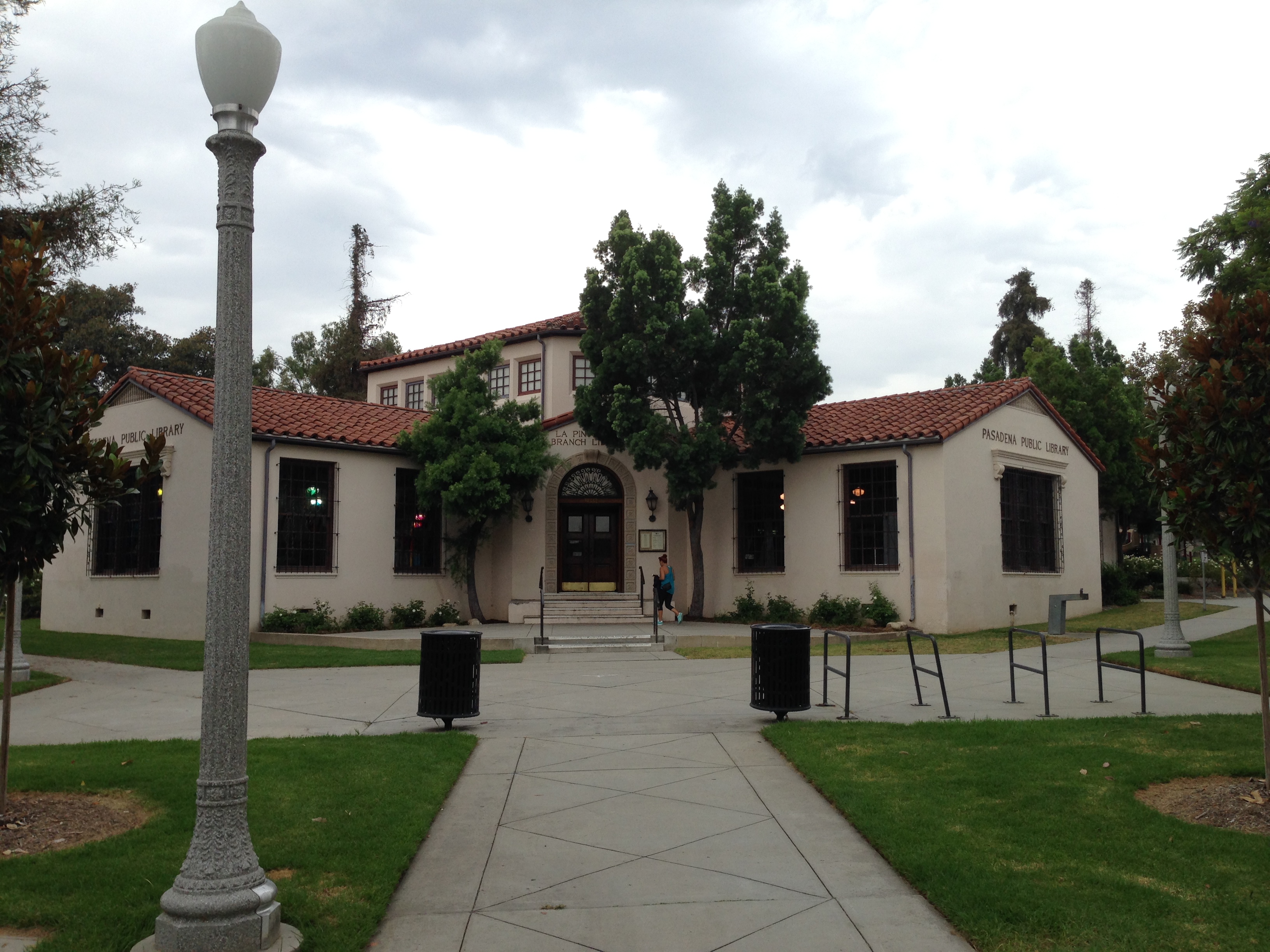
I quickly learned there is just as much research required in finding grant money as there is in finding corporate project money. The go-to database for searching foundation grants is a paid subscription service, but available for free at certain local libraries. No longer having the deep pockets of (or paychecks from) a Fortune 500 company, I trudged off to the closest library site, which is in a particularly rough neighborhood of Pasadena. After fumbling around for a couple hours on the computer terminal, I signed up for a free one-on-one with a librarian the following Friday.

My new "office" building in Pasadena.

My new office building in Pasadena, also known as the public library.

That Friday, I put on make-up and my best shorts and showed up for my appointment with Darrell at the library. He was a very kind, soft-spoken African-American gentleman who met me in the non-profit research center room, and who I was fairly certain would not care a whit about Alive and Well Women. I was itching to get started on the training, but instead of turning on the computer, he leaned back, looked at me, and asked, “What are you trying to do?” I explained I am co-founder of a nonprofit and need to learn how to use the Foundation database to find grant money. “OK, what is your nonprofit all about?” “What are your goals?” “Who is your target audience?” “How do you expect to accomplish your objectives?” “Do you have a functioning Board?” “Have you received 501(c)(3) status?” Before we ever looked at the computer, we had a 45-minute in-depth discussion about organizational planning, goals, resources, and mission. “The reason I’m asking you these questions is that I want to see how far along you are in your nonprofit, and how well you are able to articulate your vision.” To my utter astonishment, Darrell then shared his positive assessment and detailed thoughts about where he saw the need for Alive and Well Women, which was a stunning confirmation that he actually tracked with my rambling presentation.

It wasn’t at all what I was expecting, but it was exactly what I needed. By the time we finally turned on the computer, we were ready to effectively search for foundations that shared goals with Alive and Well Women. After we compiled a list of hundreds of foundations that were potential matches, Darrell gave me the homework assignment of going through each one of them to narrow the list. “Then I start calling them?” I asked. “Nope, then you do more research,” Darrell said, pointing to the volumes of resources in the shelves behind him.

Since then, I’ve spent countless hours poring over records of foundations, looking for grant limitations that would exclude them from my list, finding their stated mission and goals to see if they align with ours, and then reviewing their Form 990s for additional financial and grant information. The work is tedious and time-consuming, and I haven’t been as efficient as I’d like, and I already know I’d love to hire a intern to help someday, but I also know it is necessary for me to learn. It is almost the end of August, and I haven’t raised a dollar. But, I have become familiar with hundreds of foundations, whittled my list down to 10-15 strong matches, and assembled a good profile of each. In the process, I’ve gained a better sense of how to do research and where to find information. And in spite of my occasional frustration with the pace of progress (I must remind myself that I’ve only committed two afternoons a week – God continues to work with me on patience) I do feel a sense of accomplishment.

According to Liz Wiseman, it’s not what you know, but how fast you can learn. The Inexperienced benefit by being unencumbered by assumptions. We (I’m putting myself firmly in the Inexperienced column) solicit information by asking questions and seeking information. Rookies have a steep learning curve, and often don’t know how hard the work is at the outset. We move in baby steps at first. But rookies achieve quickly because we learn fast (we are desperate!) and are resourceful.   Liz says the learner’s advantage is that we tend to do our best thinking when our challenge level goes up. And, importantly, our satisfaction also goes up.

This past month took me back to various times in my life and career when I was new to jobs or projects or roles. It wasn’t always enjoyable, in fact often stressful, but there was also excitement and contentment in meeting the challenges. Although I don’t have the same level of risk or anxiety associated with being a “Rookie” in my current situation (I’m not worried about losing a job or salary) it is still a sharp learning curve. Liz Wiseman reminds us of the benefits of re-igniting our “Rookie Smarts,” even as leaders or at advanced stages of career or life.  She warns us that when we plateau – when things are smooth, we have all the answers, we get positive feedback, when we’re busy but bored – we start to die. On a learning curve we find the divine, the satisfaction, our greatest joy. We can and should strive to be Rookies…no matter our phase of life!

Notes to self:

  1. Look for opportunities to be a Rookie again.  Put yourself at the bottom of a learning curve. Volunteer for things you’ve never done before or look at things you’ve done before with Rookie eyes. Sometimes backward is the best way forward.
  2. Be open to unexpected mentors (like Darrell at the public library) and learn all you can from them.
  3. Be willing to mentor other Rookies when they need help.
  4. Be aware that Rookie Smart Mode can be stressful, but look at the anxiety as a sign of growth.
  5. Don’t be afraid to think like a Rookie in any situation!

Service Selection Day (Mom’s Edition)

There are a handful of days from my son’s life that stand out as extra special; days that I will never forget. He’s only 21, so, God willing, there will be many more, but as of now it is a small, cherished collection. I’ll never forget the day he was born. The day he started kindergarten.   The day his high school basketball team unexpectedly won the CIF championship. The day he received his appointment to the U.S. Naval Academy in Annapolis.

Yesterday was a day to add to the collection. It was Service Selection Day at USNA, the day that my son, along with the rest of the senior class, learned what their jobs in the military would be after graduation. They submitted their requests at the beginning of this year, and the Navy tries to honor them as much as possible, but nothing is guaranteed. Senior naval officers consider Midshipmen performance and aptitude as well as the needs of the Navy in determining assignments. There is a great deal of anxiety and tension leading up to this day. For some, this is the culmination of years of hard work leading to a hoped-for realization of a specific goal.

My son has wanted to be a pilot since he was about four years old, and a Navy pilot since about ten. It was to achieve this goal that he applied for and won an Appointment to Annapolis. At the beginning of this year, he formally requested Navy Pilot as his first choice service selection.

Since he’s a son (and not a daughter) there was, quite typically, not a lot of conversation around Service Selection Day. He mentioned the date in passing several weeks ago, and I promptly put it on my calendar (in case he forgot to tell us and we had to ask what he would be doing the next five years.) But as the date approached, I sensed it was looming large in his mind.   Last Sunday night, he brought the topic up and admitted he was nervous. He had no reason to doubt he would get pilot, but said he would be relieved to have the paper in hand. He said he would find out about 10 AM our time on Thursday.

So, here’s how Service Selection Day actually went down in our house. On Thursday morning, our cleaning lady was coming and we were rushing around getting the house ready. At around 8:30 AM, I noticed on Facebook that there was going to be a video feed of Service Selection Day for my son’s Company. So, I excitedly fumbled around on the computer and got a video feed of the empty Company ward room. While waiting for things to get going, we went back to getting the house ready. Finally, I saw a few guys file into the room on the screen and someone began talking about (as far as I could tell since it was garbled) their pay package (which I figured was the intro to Service Selection).   I saw one of my son’s friends on the screen so I texted him to say I couldn’t really understand what anyone was saying in the video feed. Then I went back to the house.

Then my son called my husband’s cell phone, and my husband was trying to get my son on speaker and he ran to the computer to see if we could see him, and he was yelling into the phone that we had the ward room on the screen and that he should go in and we would be able to see him once Service Selection started. Meanwhile, my son is saying “Dad, Dad, Dad, Dad………DAD!, DAD!, DAD!……and finally, DAAAAAAAD!!!!!” And our son shouted, “I just got my Service Selection!” And we both said “What?!” And I said something about it not being 10:00 AM so how could he get his service selection already, and how come he wasn’t on the video feed? And then we both stopped and listened and then we heard that utter joy, that utter excitement in his voice as he continued.   “I have good news!” We held our breath. “I got NAVY PILOT!!!!!!” I just remember screaming and jumping and hugging and crying a little bit. But mostly, I was incredibly relieved and happy.

The newly selected Navy Pilots from 29th Company

The newly selected Navy Pilots from 29th Company

After we hung up, I realized we were viewing the wrong video feed. We were watching an old session about their retirement program. And when we tried to watch a replay of the Service Selection video, we saw some of our son’s Company-mates, but not him.  There had been a problem with the video feed and half of the session was not captured. But, you know, it wasn’t important. We saw how the process worked and some of his friends getting their service assignments. And hearing our son’s excited voice on the phone was pure gold.

I fired off several texts and messages with the big news and then headed over to my Gentle Yoga class. Which was absolutely the wrong place for me to go right then. I was as amped up as if I’d downed 4 or 5 Red Bulls, and trying to “center” myself and “breathe” was almost impossible.. I really should have done Zumba or some other activity that would’ve allowed me to jump and dance and sing, because that’s what I really needed to do.

Twenty-four hours later, I’m still amped up. I can sometimes let the “What If’s” cause me great anxiety, and the “What if he doesn’t get pilot” was especially distressing to consider. So I am feeling relief. I am extremely grateful that one of any mom’s worse nightmares – her child suffering a crushing disappointment – did not come to pass. But, more than that, I take great joy in seeing my son achieve an important step toward his dream. Unlike grade school, where my husband and I were right there to provide assistance, prodding and guidance, this achievement was due entirely to his own efforts. I could not be more proud.

Of course, there are more trials, tests and challenges ahead before the ultimate goal of Navy Jet Pilot is achieved. But now is not the time to worry about tomorrow, because I am content to savor this moment and cherish this day.

Happy Retireversary!

Today is the first anniversary of my retirement, and in honor of the occasion I have coined a new phrase. It’s my retireversary!

In light of this milestone, it’s a good time to take stock and see how the year has gone. In an early post, I stated my initial goals for retirement:

  1. To finish cleanup projects around the house;
  2. To learn how to “do” retirement happily; and
  3. To discover rewarding activities that feed me physically, spiritually and emotionally (and perhaps financially).
This year I celebrated both my birthday and my retireversary!

This year I celebrated both my birthday and my retireversary!

I also endeavored “to avoid driving my husband OR myself crazy, OR finding myself right back on the “busy” hamster wheel doing pointless stupid activities that provide no satisfaction or compensation for my time, which would be even worse than my old job (at least I used to get paid).”

I even included a prediction of what might happen over the course of the year:

By the end of the year, my lack of a specific or well-thought-out plan for retirement or any detectable notable skills or hobbies will propel me to:

  1. Get involved in one or more volunteer, non-profit or part-time work activities that will get me out of the house and provide social interaction and an outlet for my energy but provide enough flexibility to do trips and travel; OR
  2. Stumble across some presently unknown skill or hobby which will prove all-consuming and will lead me to become, for example, the next Barefoot Contessa (cooking) or Patty Sheehan (golf) or finally win the Valley Beautiful award for our house (gardening); OR
  3. Beg for my corporate job back after we spend all of our money and/or drive each other crazy.

I found it rather amusing to read these words, compare myself a year ago to myself today. I imagined writing my self-assessment in anticipation of meeting with my Retirement Supervisor for my year-end review, but am really glad I don’t have to. This year has been extraordinary, however, and I have learned much. Although I had some broad goals, I tried NOT to make any major long-term decisions or commitments this year, and to let the next chapter of my life evolve organically. I found this approach liberating, empowering, and at times uncomfortable and frightening. Three key things I learned this year:

I will never finish all my “projects”

There are so many things I never got around to doing while I was working. All the beautifully organized scrapbooks with our family photos and my son’s cute grade school drawings and awards, my redecorated living room and dining room with the great finds from swap meets and estate sales I would go to, the dinner parties I would host, the herb garden I would plant out back, and my perfectly organized closets and garage. Since I didn’t have time while I was working, these projects were all saved for my retirement years, when I would have plenty of time. Well guess what? I still have a finite amount of time and I still have to make choices about what I do with it. And there are many good reasons (besides lack of time) I never got to these projects. Like not really wanting to or not being very good at them. So, yes, I did clean out closets and drawers this year, but the garage is still a mess. (And, since 95% of the stuff in the garage is my husband’s and he’s not all that motivated to organize and purge, I’m choosing to spend my time and energy elsewhere.) I will never finish all my projects, but I have made some wonderful memories with my husband this year.

Finding rewarding activities is key

I approached the first year of retirement as my oyster, looking for pearls to be harvested. I tried all sorts of activities that interested me. I did not stumble upon the Great Talent I Never Knew I Had (at least not yet), but I found several pursuits that were enjoyable and meaningful and  worthwhile (and some not so much). I reconnected with friends and family and tried to stay open to new experiences. I took community college courses, golf lessons, and cooking classes, enjoyed meals out with people I enjoy. I joined exercise classes at the local YMCA and found that I love yoga. I started writing a blog. I did things that fed me spiritually, joining a women’s Bible study, went on a Silent Retreat and participated in Lectio Divina (a method of praying and meditating on the Scriptures). I agreed to be on the Personnel Committee (but drew the line at also joining Session) at our church, and I have been helping a friend launch a non-profit organization. This past summer I organized a family reunion, since I’ve always wanted to have one. I’ve been able to spend more time with my college-aged son and other family. I was able to host my visiting niece on a madcap romp around LA. Sometimes it feels selfish to be focused on personal satisfaction, but I am learning that self-care is key to happiness and my ability to be fully present and compassionate with others. It is actually more selfish to expect others to make me happy.

Retirement is an adjustment

As generally happy as I have been, there have been some challenges and adjustments. One of the biggest was adapting to living in close quarters with my husband 24/7. We quickly learned that, when we are home, too much time together doesn’t work well. Once we learned to give each other permission and, in fact, encouragement to pursue individual activities, life became much easier and more enjoyable for both of us.

Which brings me back to my discussion of rewarding activities. I find I enjoy being busy and I like staying engaged with people.   My activities (almost all of which I pursue on my own) have kept me feeling energized and fulfilled, and when my husband and I rejoin for dinner at the end of the day, we have things to talk about.

At the same time, we have also found things to do together. We enjoy traveling, and have found that we particularly love road tripping. We spent almost 6 weeks together on our Route 50 / Route 66 road trip in May and June and we thoroughly enjoyed the road and each other. Trying new things together, like golf, or a new restaurant or a day trip somewhere, keeps things interesting and instills a sense of shared adventure.

Other adjustments I had anticipated were (1) learning to live with the feeling of no paycheck coming in, (2) the loss of identity or respect in losing my professional position/title, and (3) a lack of purpose in life (with no job, and potentially spending all my time in the pursuit of personal happiness). To be honest, these were all legitimate concerns but so far have not been significant worries for me. We seem to be doing just fine financially (our pre-retirement planning has paid off). I’ve found that my identity and the respect I’ve earned from people I care about have little to do with a job title or occupation. And I am, almost unexpectedly, finding great purpose in my life. I have been very intentional about seeking discernment for my next phase of life and some rather remarkable experiences give me hope and excitement for meaningful life work ahead of me.

I was recently reminded that retirement is not a one-size-fits all proposition. A friend who is my age called to tell me that he is leaving his firm and taking a new position elsewhere. He and I talked often about retirement over the years, so I expressed surprise that he was not opting to retire rather than start over at a new company. He explained that he just doesn’t feel ready for retirement, and he can’t yet envision it for himself.

As I reflected on this, I felt a renewed sense of gratitude that the timing was right for me (financially and personally) to retire and that I was blessed with the energy and life circumstances to take it on with enthusiasm. There are many who approach retirement involuntarily or warily, and it does take effort to navigate the inevitable trials and changes. For me, though, today has proven to be a Happy Retireversary!

Advice for the Route 66 Road-Tripper

Since my husband and I recently drove the entire length of Route 66 westbound from Chicago to LA (and can now call ourselves experts) it is my newfound responsibility to give sage advice to future Route 66 travelers. So then, here’s my Top 5 List:


We loved the freedom of the open road, the small towns and lack of traffic

We loved the freedom of the open road, the small towns and lack of traffic

1)   Do it!

The trip was far more interesting and rewarding than I anticipated. We saw parts of the country we never would’ve seen otherwise, and gained an unexpected real-time education about American history, culture, geography and science. We found certain sections we yearn to revisit for further exploration, and we would absolutely consider doing the whole thing again. I was disappointed when I heard that Route 66 road trips are far more popular among foreigners than Americans.   Anyone, especially an American, who loves a good road trip AND a good story unfolding before their eyes, should drive Route 66 at least once in their life!

2)   Give yourself plenty of time

Once you decide to do a Route 66 road trip, you should determine how long you are able and/or willing to spend on it, and that will dictate your itinerary. I didn’t quite appreciate this before our trip, but I can now unequivocally state that one could literally spend weeks or even months on Route 66 — if one stopped and explored all sights and side trips along the way  (like the Palo Duro or Grand Canyons). At a minimum, however, you should allocate at least two weeks (one-way), which still means a fairly aggressive timetable with minimal stops and side trips, but allowing for a reasonable daily pace. We discovered that, due to the road conditions, we couldn’t go more than about 150 – 180 miles (or 6-7 hours) per day. Plus, we made a daily stop for lunch (a highlight!) and never drove at night. If you are not able to devote two weeks, consider doing a smaller section of Route 66, giving yourself ample time to enjoy it.

3)   Decide how purist you want to be

Contrary to popular belief, Route 66 no longer technically exists. Even in its heyday, it was a patchwork of roads and highways that were designated as Route 66, and the route was constantly evolving as new roads and interstates were built and older sections replaced. The entire Route 66 was decommissioned in the 1980s.  Today it is not a well-defined or well-marked route, which is both fun and challenging.

So, when planning a Route 66 road trip, there are many choices of alternate routes and you should realistically assess your style, preferences and patience. One can follow the older versions of Route 66 (some parts of which are now dirt or gravel roads or completely disappeared) or the latest versions (which include stretches of modern Interstates) or some combination. There are guidebooks and maps available (see below) that will help you find these routes. Don’t leave home without them! We chose to mostly follow the older versions (unless it was really rough or nonexistent or there was something we wanted to see along a newer stretch), which took us through small towns and scenic countryside unfettered by traffic, but it also meant slower going and more stamina required.

 4)   Don’t over-plan….and be adventurous!

We did not leave home with a detailed pre-planned itinerary for our trip.  We knew when we needed to be back home, and had a rough itinerary (which got us home with plenty of time to spare) sketched out, but left the exact timing and route flexible.  Once we got on the road, we quickly discovered we couldn’t go as far as we anticipated each day, so our original schedule was out the door.  We basically planned each night how far we would go the next day, where we would stop for lunch, and any special sights or side trips.  We also left time to explore along the way, which gave us plenty of leeway to meander without pressure to be anywhere at a certain time. It was a very liberating way to travel!

We stopped for lunch (and often dinner) at older cafes and diners in small towns that gave us a flavor for the fare served on old Route 66. We learned much about regional food, and about the people and history from the townsfolk we met in these eateries. We found these restaurants through our Route 66 guidebooks (and then double-checked TripAdvisor to weed out the dogs). Some of the places looked dicey from the outside but, with few exceptions, they proved to be enjoyable, typically inexpensive, memorable and, almost always, tasty experiences for us. The restaurants truly appreciated our patronage (many small towns rely on Route 66 tourism for survival) and the proprietors and workers went out of their way to make us feel welcome and provide any assistance we needed.

In addition to our restaurant adventures, some of our best memories stemmed from impromptu stops or side trips that completely surprised and delighted us. Like the stop at a restored schoolhouse in an abandoned California town in the Mojave Desert where we were met at the door by the gentleman and his wife who had labored to restore the building and who gave us a personal 45-minute tour of the property. Or the visit to “Blue Hole” a natural spring in New Mexico, where we watched teenagers gleefully jumping in off the surrounding rocks. There were countless visits to Route 66 ghost towns that were both intriguing and eerie to explore.

When it came to hotels, however, we were guilty of being less than adventurous. I originally intended to stay at some of the “vintage” motels along the way. We heard that the European Route 66 road trippers love these old motels. But we found that after a long day of driving and navigating the Route 66 maps and guidebooks, we preferred a comfortable modern hotel (not Ritz Carlton but Hampton or Holiday Inn) with amenities (like a hot tub) and we learned that AAA consistently offered the best rates. Although there were some nice exceptions, most of the “historic” or “vintage” motels were more like “seedy” to me. (I admit – after many years of business travel, I’m a hotel snob.)

The bottom line is — be open to adventures to get the most out of your trip, but accept your limits and be comfortable in your journey. Nobody is going to mark you down if you occassionally drive an Interstate, or eat at a Morton’s Steakhouse, or stay at a Hilton.

5)   Do your research and use the great tools available!

Since Route 66 is fairly complicated to follow, you must do some advance research, unless you enjoy getting lost.   And even then, prepare to get lost. There are some excellent Route 66 guidebooks and maps that will save time and make your journey much easier. Our Bible was the “EZ66 Guide for Travelers” by Jerry McClanahan (we even stopped in Chandler, OK to meet him and he signed our book). It gives detailed turn-by-turn instructions for following Route 66 (and its various incarnations) and lists interesting sights along the way. When we talked to Jerry, he mentioned that his book has reportedly saved countless marriages. My husband also found “The Route 66 Map Series” by Jerry McClanahan and Jim Ross, which is a set of eight foldout maps showing the route through the 8 states through which Route 66 runs. We brought the “Route 66 Adventure Handbook” by Drew Knowles, which describes offbeat roadside attractions, vintage motels and cafes, and which we used for color commentary along the way. For finding restaurants (and theoretically lodging) we consulted “The Route 66 Dining and Lodging Guide” published by the National Historic Route 66 Federation. Pre-trip I visited the local AAA office and picked up 2 bags of maps and guidebooks, covering every state that we would be visiting. And since my husband hates to get lost, he went the extra step of using the “EZ66 Guide” to program the route for the next day into our Garmin GPS. Even so, we did lose our way a few times, but never hopelessly, and after a few days under our belt we really mastered our navigation techniques which worked like a charm. I really can’t imagine trying to follow Route 66 without the help of these maps and books.

In short, Route 66 may seem like a daunting proposition, but with a little thought and preparation, it can be the trip of a lifetime…and you t0o will be hooked!

How Route 66 Made Me a Better Person

After a short time of rest and recovery, I’ve come to the conclusion that our Route 66 road trip was a profound and life-changing experience. Not to be overly dramatic, but the sights, sounds, people, food, history and our shared adventure contributed to an extraordinary journey of discovery. And it just might have made me a better person.

Here are some things that made the journey especially meaningful:

1) Our Route 66 trip was an expedition

There are a couple of fundamental things to understand about Route 66. First of all, it doesn’t formally exist anymore. Route 66 was officially established in 1926, consisting of a patchwork of roadways. The “Mother Road” was changed and re-routed over the years, and finally, in the mid-1980’s was officially decommissioned as the Interstates replaced the older roads. Secondly, it takes diligent research and work to follow Route 66 since there are multiple variations, much of it is unmarked and some of it no longer exists. Based on our library of guidebooks, each night my husband (like a modern-day Meriwether Lewis) would plan the route for the next day, download it into the Garmin, and I (his faithful William Clark) would plot lunch, dinner and sightseeing stops. This was no casual road trip.

Our Route 66 Itinerary showing our stops

Our Route 66 Itinerary showing our stops

2) We were purist in our route selection

Since there are multiple variations of Route 66, the traveler has many options along the way: the older routes (usually frontage roads and business routes, but in some cases dirt or gravel roads), the newer roads (which sometimes included 4-lane Interstates which replaced Route 66) or some combination. We opted to mostly navigate the older roads (including some dirt) and use Interstates only when absolutely necessary. This meant we could rarely travel more than 150-200 miles per day, but it took us through small towns and countryside we would never have seen from the Interstate. And we can now proudly claim to have traversed the true Route 66!

3) Route 66 produced a vivid lesson in American history

Driving Route 66 westbound was a fascinating and experiential living classroom on American history and culture. From Chicago through Missouri, we encountered much of the odd kitsch that I expected from Route 66. There were vintage gas stations, cars and motels; a host of giant objects like muffler men, hot dogs, rocket ships, rocking chairs and neon signs, designed primarily to attract attention and lure customers. From St. Louis and especially Oklahoma westward, though, Route 66 really captured me, as it became the story of America’s westward expansion, growth pains and migration. We visited excellent museums that brought to life narratives of the pioneers in covered wagons who bravely crossed rugged western trails (precursors to Route 66), the “Okies” and other human casualties of the Dust Bowl and Great Depression (and their courage, grit and determination in the face of tremendous hardship), the traditions and repatriation of Native Americans, and the history of American vehicles – from covered wagon to Model T to Corvette. As we drove Route 66, which, unlike the Interstates, follows the natural contour of the landscape, resulting in curvy, winding roads and steep grades, we were overwhelmed as we considered what it was like for an entire family to drive these roads with all of their belongings strapped to a Model T with no air conditioning, unable to go more than 150 miles on a full tank of gas. The experience made the tales of American 20th century travel and migration fly off the pages of history books.

4) The landscape was spectacular

On the same day that I took my favorite silly photo of the trip (standing on a corner in Winslow, AZ) we also saw the Painted Dessert and the Petrified Forest.   We went from the lush green and plains of Illinois and Missouri, across the legendary Mississippi River, to the Great Plains of Oklahoma and Kansas to the cap rock and Staked Plains of the Texas panhandle to the purple mountains of New Mexico, and the deserts and mountains of Arizona and California. We saw the southernmost end of the Grand Canyon near Flagstaff. I was left in awe of the Creator of this masterpiece as well as the adaptability of the settlors of such varied habitats.

 5) We learned the importance of roadways to towns

Route 66 demonstrated that roadways are like rivers – when they are re-routed, the effect on the inhabitants is dramatic. In many cases, we drove on frontage roads or business routes right alongside the busy Interstate. Elsewhere, Route 66 was far from major highways. In all instances, there was little traffic on non-Interstate sections of Route 66, and we drove through small towns that the Interstates now bypass. Some of these small towns are surviving solely from the resurgence of tourism on Route 66; others have become eerie ghost towns; still others either ruins or completely vanished. We learned and saw first-hand how decisions (some quite political in nature) as to routing and exits of Interstates impact the very survival of these small towns and their residents. We heard story after story of occupants or even entire towns forced to relocate due to re-routing of roadways over the years.   The ubiquitous abandoned gas station we saw on every stretch was like fossilized evidence of the fluid nature of the Mother Road.

We also realized how much one misses when traveling solely on Interstates. We enjoyed seeing small towns and always made a point to stop at older establishments for lunch. We learned a great deal about the towns’ histories and cultures by talking with waitresses, proprietors and others we met. At the Lewis Cafe in St. Clair, MO, the waitress told us most of their Route 66 tourism business is now European, who see Route 66 as a uniquely American adventure and love eating at the old diners and staying at the old motels along the way. That news was surprising to me (Route 66 was hard enough to navigate without a foreign language in the mix and driving on the opposite side), and a little sad that fellow Americans are not taking the time to experience Route 66. In an older section of Albuquerque, NM, at Mary & Titos (est. 1953), a small hole-in-the-wall family-owned restaurant, we were treated to what was arguably our best meal of the trip, their award-winning carne adovada. The founders’ grandson gave us a detailed account of the peppers that are key to New Mexican cooking, and told us that many of their cooking staff have been constant for over 30 years and that few of their recipes are written (“its all in our heads”). Route 66, like a river, took us on an unforgettable passage through the core of America.

6) We had a terrific time together

I have to admit, I was a little nervous about the prospect of being cooped up in a car for at least 20 days (counting both eastbound and westbound trips) with another person (even if it was my loving husband). The potential was there to really get on each other’s nerves.

But I must say, like Meriwether Lewis and William Clark, we made a great team!  There was one day where we almost killed each other – the first day we embarked on Route 66 from Chicago. That day, I realized a Route 66 expedition ideally takes four people (the driver, the navigator, the tour guide and the photographer) and that I had three of the jobs. All was going well until we got lost in a cornfield somewhere in Illinois and an argument between driver (husband) and navigator (myself) ensued.   The situation was effectively remedied over dinner that night, when I politely tendered my resignation from the navigation committee. From then on, my husband planned and programed the routes, and followed the GPS.   That freed me to take pictures, look for and point out sights along the way (although I did try to keep an eye on the map, just in case).  Our revised system worked splendidly for the balance of the trip.

The important thing was that we worked well as a team – we enjoyed each other’s company, we resolved any disagreements that came up, and we completed the trip with an enormous sense of shared accomplishment. Although we were tired and looking forward to getting home by the end, we were surprised to both feel a real let-down at the trip end, and we almost immediately felt an itch to get back in the cherry red Traverse……..and do another Road Trip!!!!!


What I Learned on Route 50

My husband and I recently completed our first-ever cross-country road trip together, driving eastbound on Route 50 from San Francisco, CA to Ocean City, MD.  After logging 3,889 miles (including detours) through 13 states, plus the District of Columbia, and an astonishing array of landscapes, here’s my Top Ten learnings.

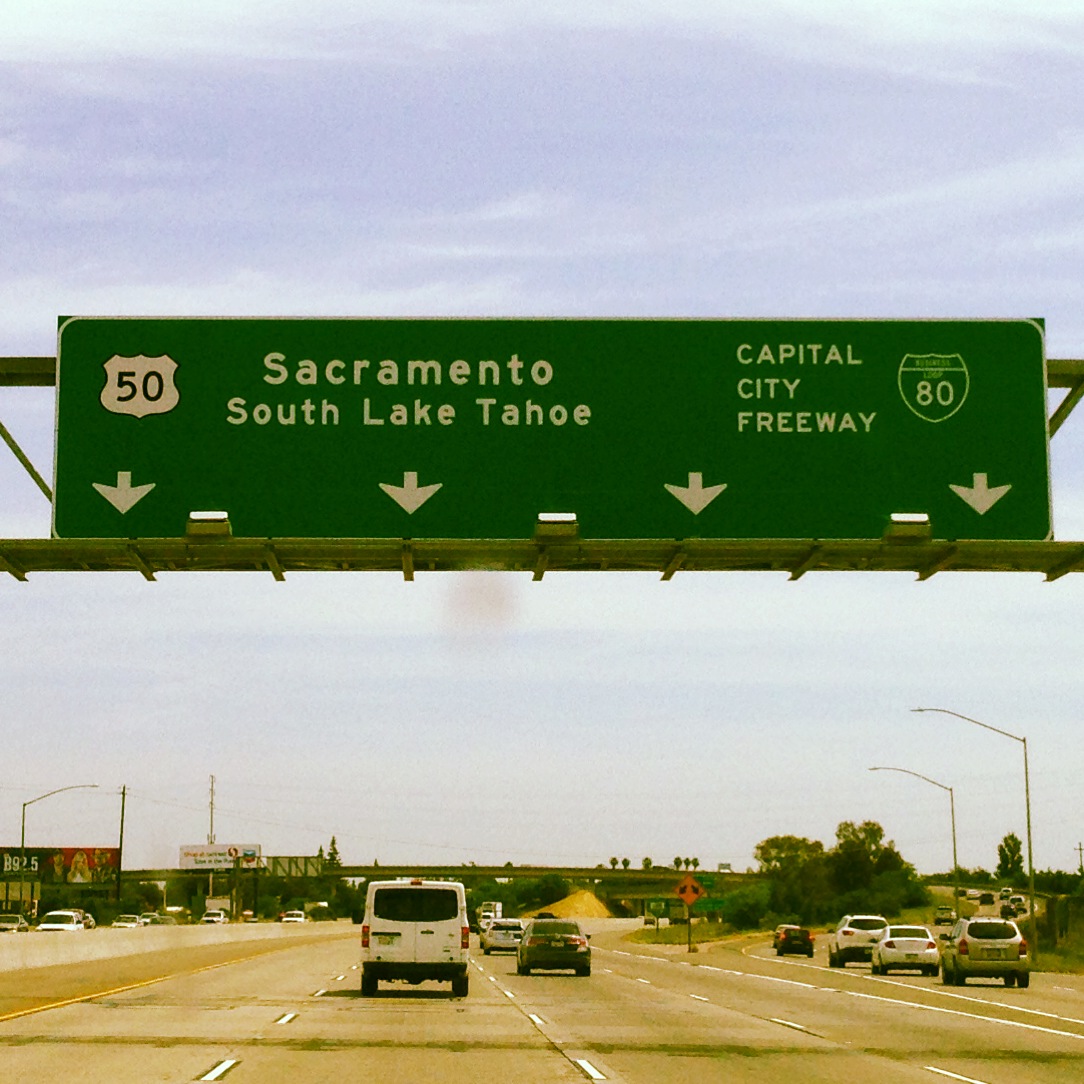
Route 50 signs

U.S. Route 50 runs east-west stretching over 3,000 miles between Sacramento, CA and Ocean City, MD

#1 – Always check multiple sources before booking a hotel room.

Before our trip, I sketched out a tentative schedule for each day, including potential hotels. We then booked rooms each night on our trip for the next night. The night before we drove to Grand Junction, CO, we found a great deal on-line at the Historic Melrose Hotel, which was mentioned in my guidebook, but was not the one I chose for my itinerary. Not remembering why, we booked it.

The Historic Melrose Hotel, which looked lovely from the outside and was in the quaint Old Town section, turned out to be affordable housing for low-income residents – one step up from a homeless shelter. Which explained the great price. Had we checked TripAdvisor (or had I remembered what I learned when I checked TripAdvisor three weeks earlier) we would have been more educated consumers. Instead, we parked the car below our room and spent the night half awake listening for sounds of a break in.

#2 – iPhones are not ideal high-speed cameras

Since we were on a fixed schedule going eastbound, we didn’t make too many stops, so I became marginally competent at taking photos from inside the car through the windshield and side windows (with attendant glare and reflections), avoiding the radar detector and GPS and rear view mirrors, at 55-65 mph. My husband would suddenly blurt “There!” and I was expected to instantaneously (1) figure out what he was talking about and (2) take a great photo of it. He would often say, “Oh, you were too slow” or “Did you frame the picture with the trees?” to which I would always reply “Got it!!” (my strategy being that whether I got it or not he would never remember). I learned where the “sweet” spots were on the windows (and some contortionist positions that worked well) and learned to take multiple photos that I would go through each night to weed out the best shots. I relied heavily on the photo editing tools in the iPhone – as long as I got the subject somewhere in the photo, I could enlarge and crop and lighten. Even so, in addition to a few good shots, I have an impressive library of blurry, blank, and unidentifiable transcontinental pictures. My photo of the Iwo Jima Memorial in Washington, DC looks right out of “The Blob” (my favorite vintage horror movie).

#3 – Make lunch stops a priority 

Because we didn’t make too many impromptu stops along the way, our lunch breaks were a highlight of each day. Sometimes we were tempted to power through without lunch, but I’m glad we didn’t. First, they provided a much-needed respite from the car and driving. But more importantly, they were consistently fun. We tried to find little towns and older restaurants characteristic of Old Time America. We learned about the towns we visited by chatting with the waitresses and proprietors that we encountered. In Eureka, NV (Pop 610) our waitress told us she had 17 in her graduating class in high school. She said her school offered all the usual sports, but every student had to play most sports in order to have enough players to field teams. In Olney, IL (pop 7.994) , home to a colony of albino squirrels, our waitress instructed us that the best way to see squirrels was to visit the city park with McDonald’s French fries.

 #4 – Rest days were like a stop at the oasis

We spent 12 days traveling across country, but two of those were rest days. On one rest day, we visited dear friends in the Denver area. On the other, we visited my brother in St. Louis.

While in Denver, we had two home-cooked dinners, slept in a quiet comfortable room on a super-comfy bed, took a leisurely tour of the local area, and caught up with our friends. In St Louis, we were also fed and put up in our own cozy room, and got precious quality time with family we don’t see often. Although my husband initially questioned the need for rest days, we later agreed that they really helped us recharge and get back on the road fully energized.

#5 – You must be smarter than your GPS

Our Chevy Traverse has a built-in GPS system, which we have found to be rather clunky. We’ve had to learn multiple workarounds to get it to do what we need. Therefore, we also travel with our portable Garmin as back-up.   In a pinch, I also fire up Google Maps on my iPhone. And of course, there is the iPad.

There were many days when I joked to my husband that he was in the unenviable position of driving with 4 women (including me) telling him where to go. And even with all the help, the Navigator was still a full-time job for me and I had to know where we were at all times and not rely on GPS. Since we were trying to stay on Route 50 (not necessarily the fastest or shortest route) I had to learn tricks to outsmart the GPS (with waypoints, etc.) to get where we wanted to go and mediate disputes between the “women” (our GPS systems).  But then there was the time we drove right by the bank that was just down the street from our hotel because were so busy fiddling with the GPS rather than just looking at the address.

Even with all the gadgets….

#6 – In addition to the [multiple] GPS systems, you still need maps

Before we left on our trip, I visited the local AAA office and picked up 3 bags of maps and tour books, covering every state we intended to travel. Thank goodness, because we would otherwise have been at the mercy of our GPS systems and probably lost somewhere in Kansas. It was essential to get a sense of the route before programming the GPS, plus it was more meaningful to follow along on a map as we drove. The maps told me more details about what we were seeing (rivers, mountain ranges, etc.) so I could act as self-appointed Tour Guide.

#7 – Don’t travel with just one big heavy suitcase.

We retrieved our luggage sets from the garage before we left, and packed our big suitcases since we would be gone for an extended period. We had every intention of bringing along the smaller weekend bag or the smaller roller bag that went with our sets, but for some inexplicable reason we forgot them.

As a result, every night as we checked into a new hotel (always requesting a second floor room) we found ourselves lugging incredibly heavy suitcases with everything we owned out of the car, across the parking lot and up the stairs.   Then our room (being typically Comfort Inn rather than Ritz Carlton) was almost completely filled with suitcases. We looked like the Kardashians, or more the Beverly Hillbillies, checking into town.

After a couple nights of this nonsense, I started using an empty tote bag I’d brought along to pack one or two nights’ provisions so I wouldn’t have to mess with the Two Ton Suitcase. I will definitely bring that weekend bag along next time, in addition to the Big Suitcase, and plenty of tote bags for flexibility.

 #8 – Document the trip as you go

After about Day 4 or 5, I couldn’t tell you with any conviction where we had been even the day before for lunch. It all became a blur. I found the written itinerary listing all of the lunch and dinner stops and hotels very helpful, and I learned to note any changes or any additional sights we saw along the way. That way, between the photos and the itinerary, I should be able to reconstruct a decent memory book of our trip.

#9 – We need to find a balance of driving and stops

This trip was a little too much driving with too little sightseeing for me. Since we were on a fairly strict timetable, we didn’t have much time for spontaneous exploration of sights and attractions along the way. There were a few unscheduled stops we made – to see the remnants of an old pony express station in Nevada (or was it Utah?)- that were interesting, but for the most part we simply saw what we saw from the car along Route 50. On our next trip, along the old Route 66, we plan to meander more. The trip did give me ideas, however, of places to return to see (Kansas City, for example) in more depth.

#10 – America is a really incredible country

Driving through the entire middle of the continental United States was a thoroughly amazing experience. The vast and varied landscape, from the barren desert of Nevada to the rugged mountains of Colorado to the great plains of Kansas to the lush West Virginia countryside, simply took our breath away. There were days that we turned off the radio and sat in silence taking in the magnificent beauty of the scenery before us. We so enjoyed our encounters with the people we met in small towns across the country. We will never forget the day we smugly stopped for a photo of ourselves at Monarch Pass (elev 11,312) at the Continental Divide in CO and we met two young men who had RIDDEN THEIR BIKES from San Francisco. We emerged from our trip more in awe of the spirt and beauty of this extraordinary nation and its people.

The Loneliest Road in America

And…we’re off!!! On the Great American Road Trip. Our first night was spent at my sister-in-law’s house in the Bay Area. The next day we crossed the San Francisco Bay Bridge and drove to Sacramento, where at twelve noon, ON THE DOT (not planned, but how dramatic!) we hit the start of Route 50 and the Official Route 50 Road Trip began.


The beginning of Route 50, just west of Sacramento, CA

The beginning of Route 50, just west of Sacramento, CA

From Sacramento, we drove to Fallon, NV. Our scheduled lunch stop was in South Lake Tahoe, CA at the Red Hut Cafe. The Guidebook urged a stop here at the circa 1959 cafe – the original of several locations. As we pulled up, the neon “Open” light suddenly switched to “Closed” and my heart sank, worried this did not bode well for our trip. I pulled out my iPhone ready to locate another restaurant, when I noticed 3 women milling about in the café and jumped out to talk to them.   These incredibly friendly women (who worked there) informed me that the café just closed but there was another Red Hut right down the street, which was still open. We proceeded to the other Red Hut and had a lovely lunch overlooking Lake Tahoe.

After tooling around stunning Lake Tahoe a bit, we continued to Fallon for the night (crossing the Nevada border at 3 pm ON THE DOT). Up to that point, I hadn’t covered any new ground. Beginning in Fallon, I saw new sights, including the Fallon Naval Air Station (which hosts the Top Gun school) where my son may be stationed someday.

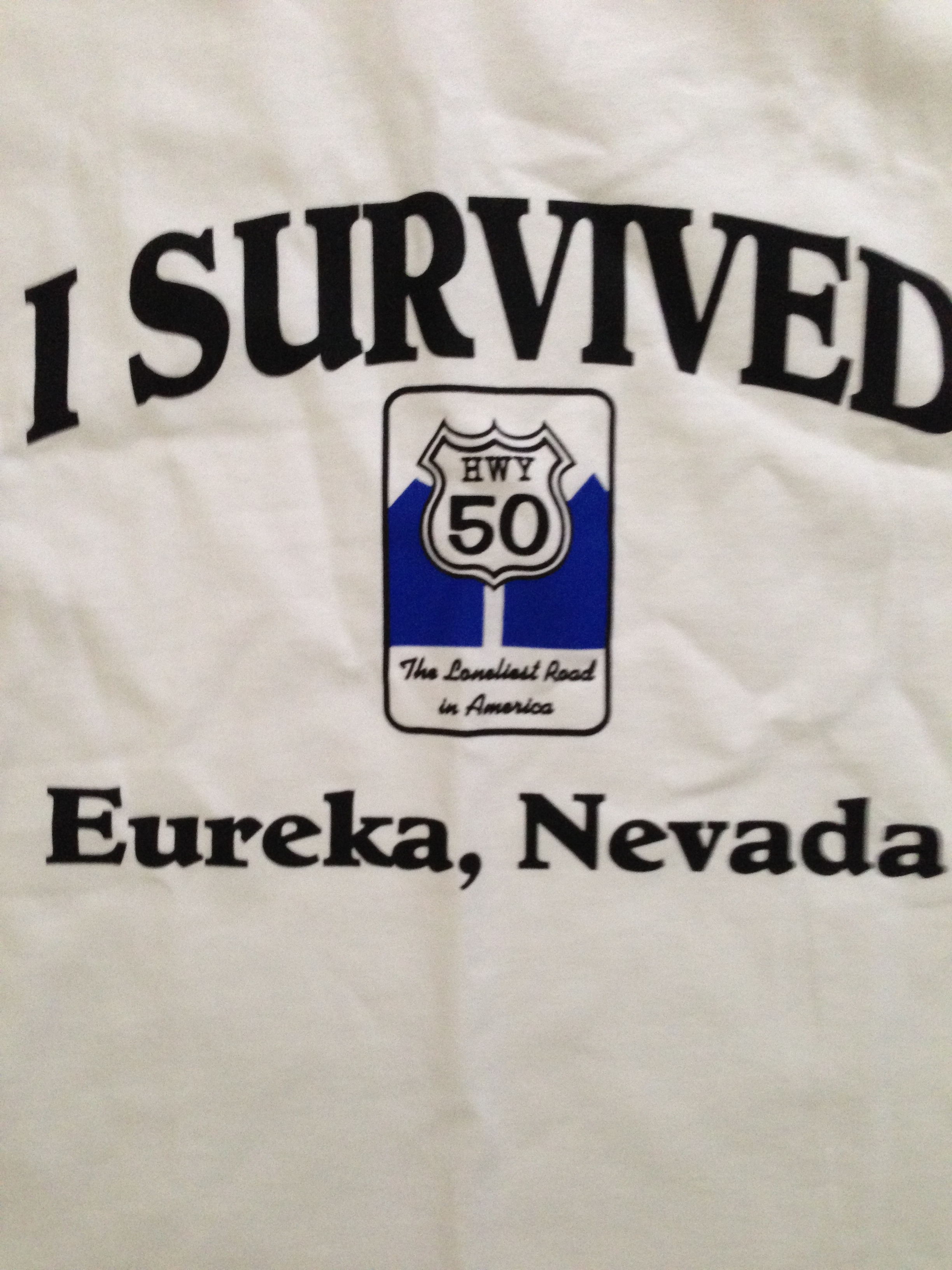
The t-shirt I picked up at the Chevron station in Eureka NV

The t-shirt I picked up at the Chevron station in Eureka NV

Also beginning in Fallon is the stretch of Route 50 dubbed “The Loneliest Road in America.” By the end of that day, we completely understood the moniker. Between Fallon, NV and Delta, UT, we encountered 410 miles of generally straight road, sagebrush, mountain and blue sky. We rarely saw other cars or people. There was no Internet coverage. Our lunch stop was in tiny Eureka, NV, where our waitress told us that her entire graduating high school class consisted of 17 students. While the school offered sports, the students had to play all of them to field enough players for the teams.

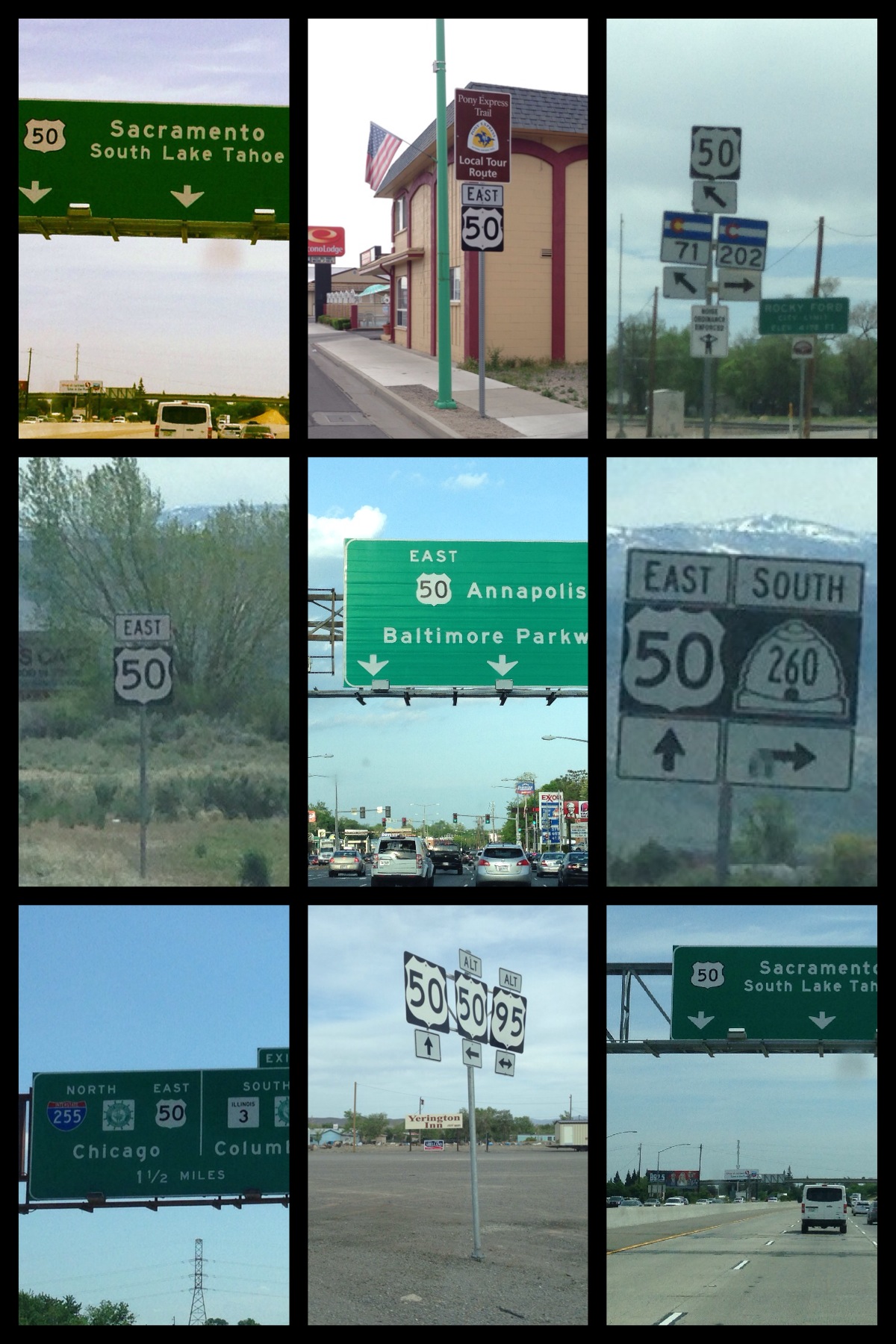
The scenery was striking, but hour after hour of relative uniformity became monotonous. I amused myself initially by taking pictures with my iPhone. After 30 or 40 landscape photos looked identical, I switched my focus to Route 50 signs. I found myself increasingly dazed, and the Route 50 signs snuck up on me. It was not easy taking clear photos at 70 mph through the car window or windshield, with the reflection and the GPS and radar detection in the way. Add my trance-like state, and dull reflexes, and an extensive library of blurry Route 50 sign photos resulted.


The collection of photos I took with my iPhone on the stretch of Route 50 known as "The Loneliest Road in America"

The collection of photos I took with my iPhone on the stretch of Route 50 known as “The Loneliest Road in America”

My next coping mechanism was my Easter chocolate. After 6 dark chocolate eggs and a marshmallow patty, I felt alive again with the sugar coursing through my veins. After a couple more hours, however, the blood sugar plunged and fatigue really hit us. So we reverted to our secret weapon – Disney songs. For the next few hours, we sang along with our entire Disney Collection at the top of our lungs. From Sleeping Beauty to Jungle Book to Mulan to Pocahontas, we sang all the parts, amazing ourselves at our mastery of the lyrics (from all those years of Disney music when our son was younger).   We came alive!   We had fun! We were silly! Thanks to chocolate and Disney, the Loneliest Road in America turned out to be anything but, and a surprisingly splendid start to our Great American Road Trip.